The vines here grow higher than most people expect. Seven hundred metres, sometimes a thousand, on limestone that holds the cold of the night and gives it back slowly through the morning. It is the reason a red from the Serranía tastes nothing like the Andalusia most visitors arrive expecting.
Wine tasting in Ronda is not a large industry. There are around twenty bodegas scattered through the hills between Ronda and Arriate, most of them small, many of them family-run, several still tended by the people who planted them. You will rarely find a crowd. You will often find the owner pouring.
This guide is written from among those hills. It covers what a visit involves, what it costs, which bodega suits which kind of traveller, and how to reach them, whether or not you have a car.
What a Wine Tasting in Ronda Actually Involves
Almost every winery here works by appointment. Very few have a tasting room you can simply walk into, and this is worth knowing before you arrive with an afternoon free and no plan.
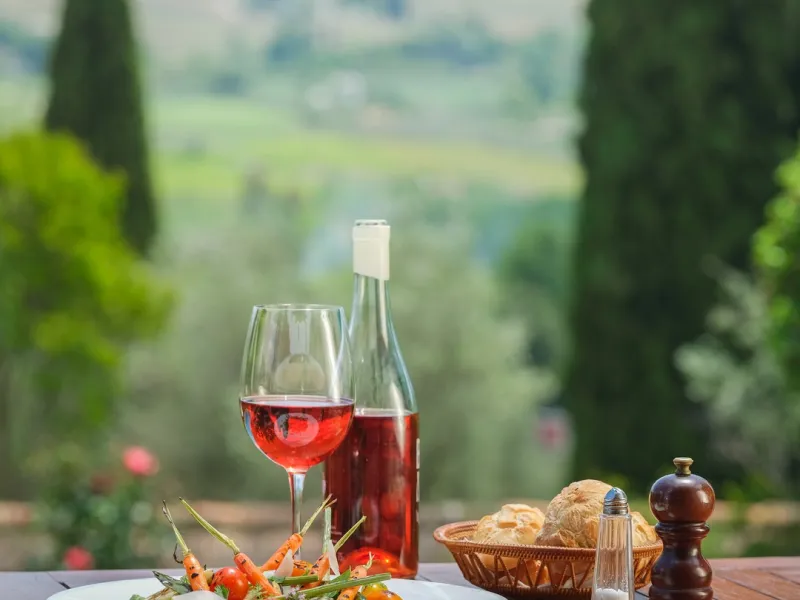
A typical visit runs between one and two and a half hours. It usually begins in the vineyard, walking the rows while someone explains the altitude, the soils and the varieties, and continues into the cellar before the tasting itself. Expect three to six wines, most often poured alongside local cheese, ham and bread, sometimes a fuller meal if arranged in advance.
Prices sit broadly between fifteen and fifty euros per person, depending on the winery and how much food is included. The average lands somewhere near thirty-five. Groups are small by necessity, and several bodegas ask for a minimum number of guests, so a call or an email a few days ahead makes the difference between a good afternoon and a locked gate. Tastings are usually offered in Spanish and English, and often in German or French. Ask when you book.
One to two and a half hours, including a vineyard walk, the cellar and the tasting itself.
Between €15 and €50 per person, averaging close to €35. Tapas are usually included.
Essential. Nearly all bodegas visit by appointment, and some ask for a minimum group.
The Bodegas Worth Your Afternoon
Six wineries, each with a different reason to choose it. Distances are given from the centre of Ronda.
Descalzos Viejos: For Architecture, and for Those Without a Car
A 16th-century convent on the very lip of the Tajo, where steel vats now stand beneath frescoes that have not moved in five hundred years.
Restored at the end of the nineties, the old convent holds one of the most quietly astonishing tasting rooms in Andalusia. The original paintings remain on the walls. The wines are small-production blends led by Syrah, with a Chardonnay among them, and the terrace looks straight down into the gorge.
Good to know
- Around three kilometres from the centre of Ronda, and walkable if you are willing.
- Groups are deliberately small. Book several days ahead, particularly at weekends.
- Best for couples, architecture lovers, and guests staying in Ronda without a car.
Bodega F. Schatz: For the Serious Wine Lover
Friedrich Schatz arrived from South Tyrol in 1982 and began what many consider the revival of winemaking in these mountains.
Nine varieties are grown here, including Lemberger and Moscatel Negro, all farmed biodynamically and bottled without shortcuts. Visits take in the vineyard, the cellar and a tasting of four to six wines, with the kind of explanation that assumes you are genuinely curious.
Good to know
- Roughly ten kilometres north of town, on the road towards Ronda la Vieja.
- Allow a full morning. This is not a visit to hurry.
- Best for anyone who reads back labels, and anyone curious about biodynamic farming.
La Melonera: For the View, and the Story
A hilltop bodega of glass and stone near Llano de la Cruz, looking out across Arriate and the wooded valley below.
The project set out to recover varieties lost to phylloxera in the 19th century, among them Romé, Blasco and Tintilla. Payoya Negra is the wine most people remember afterwards. Visits last around two and a half hours and include tapas taken with the whole Serranía in view.
Good to know
- About eleven kilometres from Ronda, out towards Setenil.
- Late afternoon is the hour to ask for, when the light turns over the vines.
- Best for first-time visitors, and anyone who wants the landscape and the wine in the same frame.
Cortijo Los Aguilares: For Depth Without Ceremony
An estate where the vineyards share the land with holm oaks and grazing, and Pinot Noir does something it has no business doing this far south.
North of town on the Ronda to Campillos road, these are reds with a following well beyond Andalusia. The visit is unshowy and the wines do the talking, which is precisely why people return.
Good to know
- By appointment only, on the A-367 towards Campillos.
- Pairs well with a second bodega on the same road, if you have a driver.
- Best for guests on their second or third visit to Ronda, ready to go beyond the introduction.
Bodega Doña Felisa: For a Longer, Gentler Afternoon
One of the first wineries in the Serranía to open its doors properly to visitors, and it still shows in how the visits are run.
Producer of the Chinchilla wines, set among its own vineyards off the road to Ronda la Vieja. Unhurried, warm, generous with time, and happiest with a small group around the table rather than a schedule to keep.
Good to know
- Visits are usually arranged for groups of five and upwards.
- Nine kilometres north of Ronda, along the MA-7402.
- Best for small groups and travellers who prefer conversation to formality.
Bodegas García Hidalgo: For Value, and for Lunch
A family winery in the green of the Guadalcobacín valley, where the tasting has a habit of turning into a long lunch.
Eight kilometres out on the Arriate road, producing organic wines under the Alcobazín label. You can take a simple tasting with tapas, or stay on for a fuller table with paella and dessert, which is the version most guests end up choosing.
Good to know
- The most affordable serious tasting in the area, with meal options on request.
- Say at the time of booking whether you want the tapas or the full table.
- Best for those who want the food to be as much of the visit as the wine.
Which Wine Experience Is Right for You
Descalzos Viejos. Close to town, an extraordinary setting, and no long drive at either end of the day.
Descalzos Viejos on foot, or a taxi to one of the northern bodegas for roughly €10 to €20 each way. One visit by taxi is reasonable. A circuit of three is not.
Descalzos Viejos or La Melonera, late in the day, when the light on the limestone turns and the tasting slows of its own accord.
F. Schatz or Cortijo Los Aguilares, and give them the whole morning rather than an hour between other plans.
Take the day, but take a driver. The roads into these hills are beautiful and narrow, and the point of a tasting is rather lost if one of you cannot join in. Two bodegas plus the old town makes a full but unhurried day.
Why the Wine Here Tastes Different
Winemaking in the Serranía is ancient and was very nearly lost. Phylloxera, war and poverty ended a tradition stretching back three thousand years, and for most of the 20th century the vines simply were not here. What exists today was replanted, largely within living memory, by a handful of people who believed the land was worth the trouble.
What the land gives
- Altitude. Between seven hundred and a thousand metres, the nights stay cold even in August, so the grapes ripen slowly and hold their freshness.
- Limestone. It drains hard and forces the roots down, which is where the mineral edge in these wines begins.
- The hillsides themselves. Rosemary, thyme and rockrose grow between the vines, and you will find them in the glass more often than you expect.
The results are reds with structure and lift rather than heat: Petit Verdot, Syrah, Tempranillo, and the recovered native varieties like Romé and Tintilla that are quietly becoming the region’s signature. The whites, Chardonnay and Sauvignon Blanc among them, are sharper and more mineral than their latitude suggests. Production is small, and many of these wines never leave the province. That is part of why tasting them here, rather than reading about them, is the only real way in.
Getting to the Wineries
Most bodegas cluster north of Ronda along the MA-7402 towards the Roman ruins at Acinipo, or along the roads to Arriate and Campillos. Distances are short, between three and fifteen kilometres, but these are country roads and the signposting is modest.
Simplest, provided one of you is content not to taste. Several bodegas north of town sit within twenty minutes of one another.
€10 to €20 each way from Ronda to most bodegas. Ideal for a single visit, less so for a circuit.
Descalzos Viejos is around three kilometres from the centre, downhill on the way out and worth the climb back.
We are glad to arrange the booking, the timing and the drive, and to have a table waiting when you return. You need only say the word at breakfast.
The Evening After
There is a version of this day that ends in a car park at six o’clock, and a better one.
Guests come back from a tasting flushed with mountain air, and the afternoon does not end. It softens: a swim, a book, the shade of the terrace, the light going long and gold over the valley.
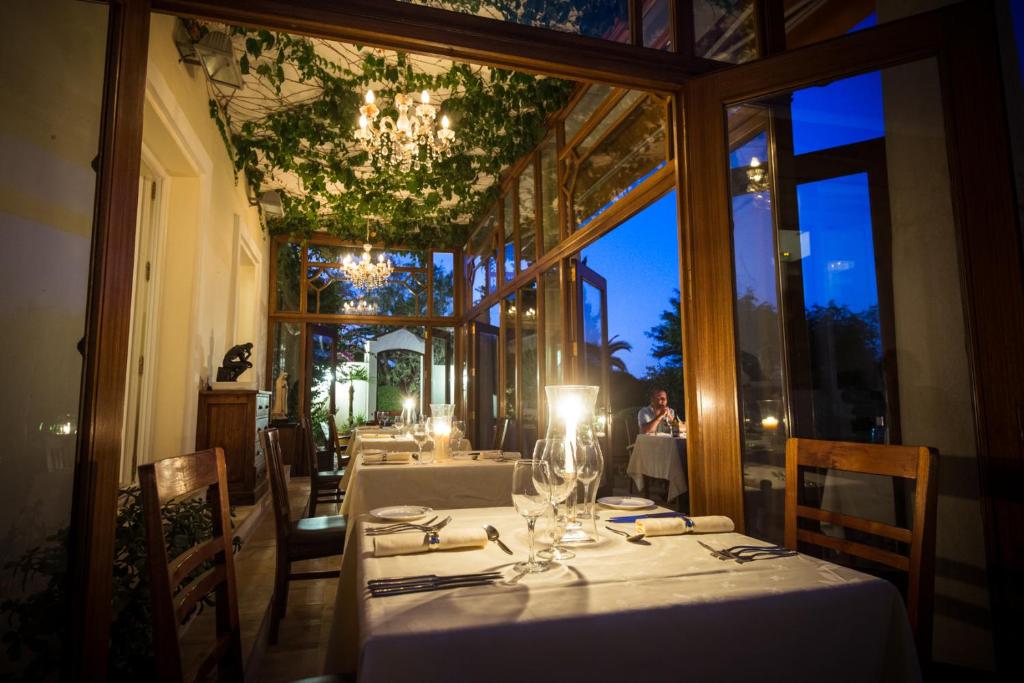
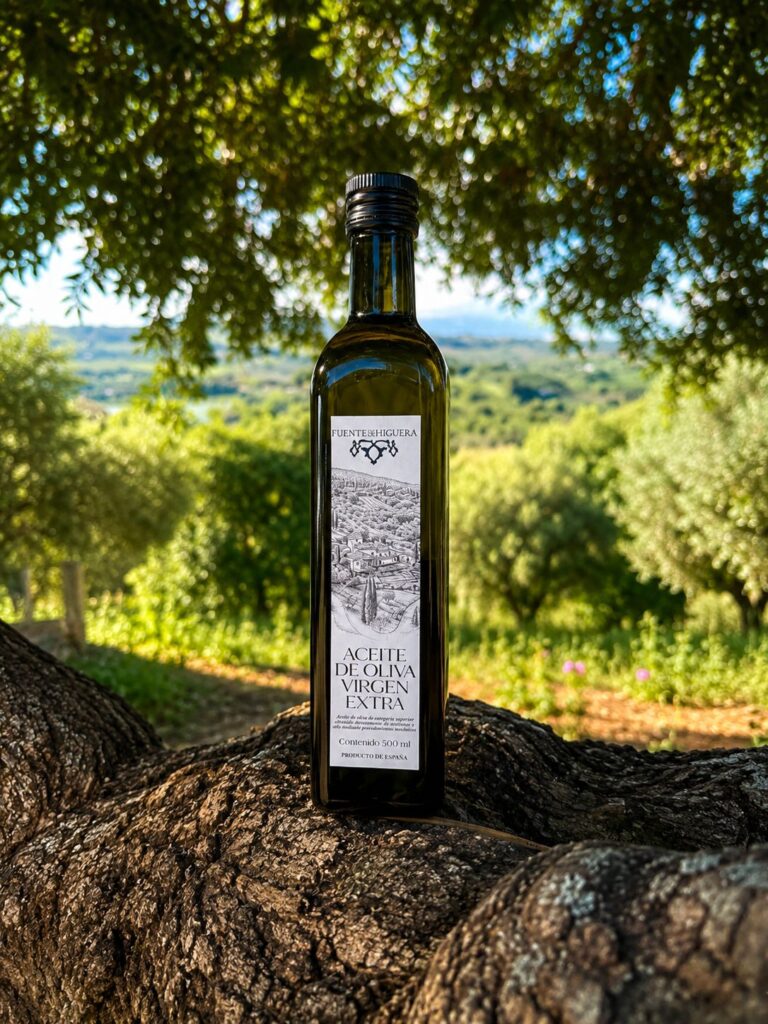
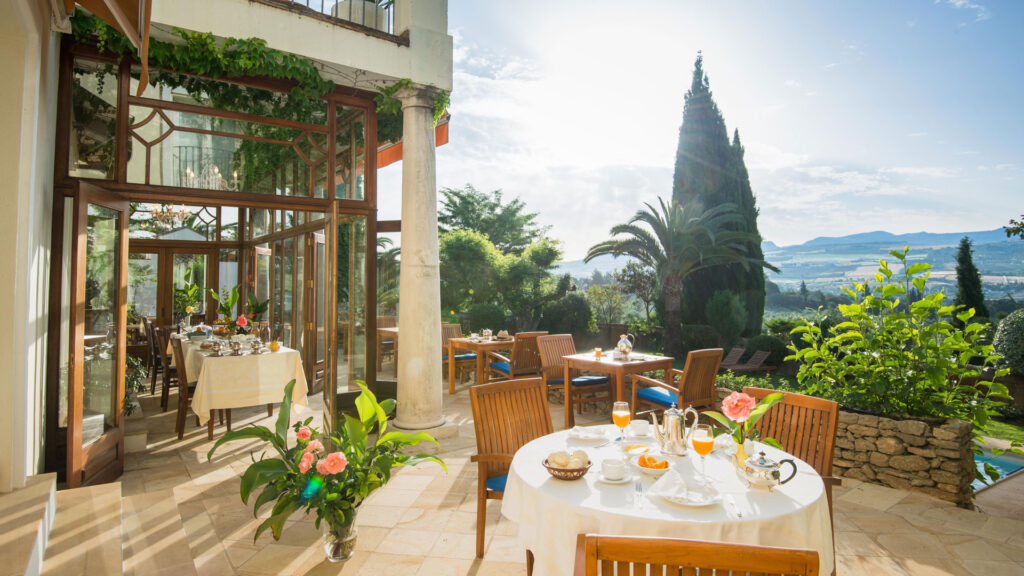
Hotel La Fuente de la Higuera sits a few minutes from Ronda, in an 18th-century olive mill among gardens and groves, with the Serranía filling every window. Dinner is served outside among the orange and lemon trees. The menu changes every evening and has done for twenty-five years, built around what the kitchen garden gave that morning and finished with our own olive oil, pressed from lechín olives grown here. On the list are the wines you spent the afternoon among, poured by people who know the families who make them. When you are ready, we would be delighted to welcome you.
You can come to us for dinner alone, and many do. But the wine, the table and the silence afterwards belong together, and the drive home is the one part of the evening nobody remembers fondly. Stay the night, and the last thing you see is the Andalusian sky doing what it does over these hills when there is nothing else lit for miles.
Wine tasting in Ronda is best taken slowly, and so is everything that follows it.
Wine Tasting in Ronda: Frequently Asked Questions
How much does a wine tasting in Ronda cost?
Most visits fall between €15 and €50 per person, with the average close to €35. The price usually covers a vineyard walk, a cellar tour and a tasting of three to six wines with local tapas. Longer visits with a full meal cost more.
Do I need to book a wine tasting in advance?
Yes. Almost every bodega in the Serranía works by appointment, and several ask for a minimum group size. A few days’ notice is usually enough, though harvest season and weekends fill sooner. We are glad to arrange it for our guests.
How long does a winery visit take?
Between one and two and a half hours, depending on the bodega. Allow half a day if you are travelling out to one of the northern wineries and want to linger over the tasting.
Can I do a wine tasting in Ronda without a car?
You can. Descalzos Viejos is around three kilometres from the centre of Ronda and reachable on foot. For the others, a taxi costs roughly €10 to €20 each way, and several operators run tours from Ronda with transport included.
What wines are produced in Ronda?
Mostly reds: Syrah, Petit Verdot, Cabernet Sauvignon, Merlot, Tempranillo, and recovered native varieties such as Romé and Tintilla. Whites include Chardonnay, Sauvignon Blanc and Macabeo. The wines belong to the DO Sierras de Málaga, within the Serranía de Ronda subzone.
When is the best time of year to visit a winery?
Spring and autumn. April to June brings wildflowers through the vineyards, and September to October brings the harvest, when the bodegas are at their most alive. Summer visits are best taken early in the morning or late in the day.
Can I visit a bodega and see Ronda on the same day?
Comfortably. A tasting takes a morning or an afternoon, leaving the other half of the day for the Puente Nuevo, the old town and the bullring. Two bodegas plus the town makes for a full but unhurried day.
Is a wine tasting in Ronda suitable for beginners?
Very much so. These are small wineries used to welcoming people who simply enjoy wine rather than study it. Say so when you arrive, and the visit will shape itself around you.